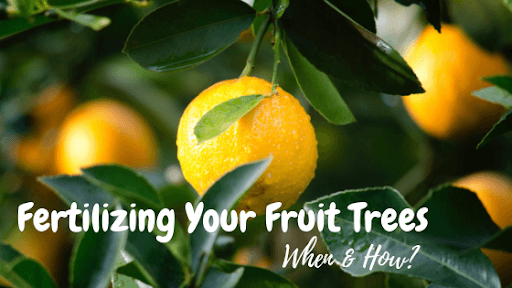
For your fruit trees to produce a bountiful harvest, providing them with the right nutrition is essential. Just like vegetables, flowers, and other plants in your garden, fruit trees require supplemental nutrients to truly thrive and yield luscious fruit. Without these key elements, they might struggle to grow, become more susceptible to diseases, or produce a disappointing crop. Understanding when and how to give your fruit-bearing plants this much-needed boost is key to their success. Keep reading to learn the best practices for fertilizing your fruit trees.
When to Fertilize?
Keep in mind that there is definitely a right time to fertilize and that is just before the bud break. This is when your trees are beginning their annual growth cycle and this is the time when they need and eat food the most.
Ideally, you should fertilize your fruit trees about a month before they begin to bloom. This gives the nutrients ample time to integrate into the soil and be available for the tree as it enters its active growing phase. However, if you’ve missed this optimal window and your trees have already started flowering, don’t worry. You can still apply fertilizer up until June without causing harm. Look up at the canopy and apply fertilizers evenly underneath the dripline, where the majority of the roots are located.
It is strongly advised NOT to fertilize in the late summer or fall. Fertilizing during this period encourages new, tender growth that won’t have enough time to harden off before the first frost. This delicate new growth is highly susceptible to damage from the extreme cold of winter, which can stress the tree and reduce its overall health and fruit production for the following year. If you find yourself late in the season but still feel your trees need a nutritional boost, you can safely mulch them with compost and top-dress with a gentle nutrient like soft-rock phosphate. However, you should avoid all nitrogen-heavy fertilizers at this time, as nitrogen is the primary stimulant for new leaf and stem growth.
Measure Before You Apply
According to a local Waco Tree Care Expert, a trees’ need for fertilizer varies widely from species to species. Not all trees need annual fertilizers. This can change from year to year and depends on a number of factors. So, it is important that you observe and interact with your fruit-bearing trees.
Too much fertilizer can be detrimental, leading to excessive leaf and shoot growth at the expense of fruit production. This rapid, lush growth often results in weak, spindly branches that are more susceptible to breaking under their own weight or from wind and fruit load later in the tree’s life. Essentially, you’re encouraging the tree to grow foliage instead of focusing its energy on developing strong, fruit-bearing structures.
Too little fertilizer, on the other hand, can cause noticeably slow growth and overall under-performance. This means you might not get the abundant harvest you’re hoping for. If your trees are planted in poor, nutrient-deficient soil, providing adequate fertilizer is crucial. Neglecting to do so can lead to serious issues, including visible nutrient deficiencies (like yellowing leaves), poor tree health, and a weakened immune system, making the tree more vulnerable to diseases and pest infestations.
Fortunately, your fruit trees can signal their needs. You can determine the right amount of fertilizer by taking simple measurements of their annual growth. This is best done in the winter or early spring while the tree is dormant and before the new season’s growth begins.
How to Measure your Trees’ Growth?
- Locate the last year’s growth rings. This is the point on the branch where the tree started growing in the last season. The growth that you are to measure is often a different color than the rest of the branch.
- Measure from the growth ring all the way up to the end of the branch. Repeat this at several spots around the tree.
- Calculate the average of the measurements. This will be the annual growth of the tree from the previous season.
You will have to take time and repeat doing this series of steps for each of your trees since even trees of the same variety and age may not have grown at the same rate, thus they would have different fertilizer needs.
Evaluate Averages
Use the guide below to evaluate your trees’ annual growth. If a tree’s growth rate is at the low end like with Maples, or below the annual target growth, then it is a must that you fertilize this specific tree this year.
For trees that have a positive growth, or at the high end or above the annual target growth rate, there’s no need to fertilize for this year. But it’s important to measure again next year for any changes.
- Non-bearing young trees
- Peaches and nectarine should grow 18”-24”
- Apples and pears should grow 18”-30”
- Plums and sweet cherries should grow 22”-36”
- Tar Cherries should grow 12”-24”
- Mature bearing trees
- Peaches and nectarine should grow 12”-18”
- Non-spur apples and pears should grow 12”-18”
- Spur apples should grow 6”-10”
- Plums and sweet cherries should grow 8”
- Tar Cherries should grow 8”
Choose the Right Fertilizer with Enough Slow-Release Nitrogen for Tree Fertilization
Fruit trees should be given organic, high nitrogen fertilizers. Good organic nitrogen sources are as follows:
- Blood meal
- Soybean meal
- Composted chicken manure
- Cottonseed meal
- Feather meal
In addition to nitrogen, your trees require a balanced diet of both macro and micronutrients to thrive. Macronutrients like phosphorus and potassium are needed in larger quantities, while micronutrients such as iron, manganese, and zinc are essential in smaller amounts. Adding a layer of rich compost every time you fertilize is an excellent way to introduce organic matter and a broad spectrum of these trace minerals into the soil.
To get a precise understanding of your soil’s composition, conducting a soil test is highly recommended. This test will reveal if crucial nutrients like phosphorus or potassium are deficient and need to be supplemented in greater amounts. If your soil test comes back normal and your trees continue to show signs of distress, such as discolored leaves, stunted growth, or dieback, it might be time to consult an expert. A certified arborist, like those at Riverside arborists for advice on tree diseases, can accurately diagnose underlying issues, including diseases or pests. Seeking professional help early can often save a tree before the problem becomes too severe, preventing the need for complete removal.
Calculate the Right Fertilizer Amount
As discussed earlier, it is important that you don’t give too little or too much fertilizer as this can harm your trees. Below is a guide you can follow to determine the correct amount of fertilizer to use on each tree:
- Trees need 0.10 pounds of “actual nitrogen” per year of age, or per inch of trunk diameter which is measured 1 foot above the ground. Do not exceed 1 pound of actual nitrogen per year. If your tree has a diameter of 5 inches (or, if your tree is 5 years old), multiply 5 by 0.10 pounds of nitrogen, equals 0.5 lb. So, your tree needs 0.5 lbs of actual nitrogen.
- Keep in mind though that “Actual nitrogen” is not as simple as just weighing out that amount of fertilizer, because there is more in a fertilizer than just nitrogen.
- Note that the NPK numbers on fertilizer show the percentage of nutrients per pound of fertilizer, not the actual amount. N, P, and K refer to nitrogen, phosphorus, and potassium respectively.2. Let’s take an example. If the N listed on the fertilizer package is 7 (meaning 7% nitrogen), such as with E.B. Stone’s Fruit Tree fertilizer, then there are 0.07 pounds of actual nitrogen for every pound of fertilizer.
To calculate how much fertilizer to apply to your tree, you need to perform a simple calculation. The basic formula is to divide the total amount of nitrogen your tree requires by the percentage of nitrogen present in the fertilizer you’ve chosen.
Let’s walk through the example we’ve been using. A five-year-old apple tree generally needs about 0.5 lb. of actual nitrogen per year to thrive. If you’re using E.B. Stone Fruit Tree Fertilizer, you’ll notice it has an N-P-K value of 7-3-3 on the package. The first number, 7, represents the percentage of nitrogen (N) in the fertilizer. This means that for every pound of this fertilizer, there is 0.07 lb. of actual nitrogen.
To figure out how much of this specific fertilizer to use, you’ll divide the tree’s nitrogen need (0.5 lb.) by the nitrogen content of the fertilizer (0.07).
So, the calculation is: 0.5 ÷ 0.07 = 7.14.
The answer is approximately 7 lbs. This means you will need to apply about 7 pounds of the E.B. Stone Fruit Tree Fertilizer around your five-year-old apple tree to give it the 0.5 lb of nitrogen it needs for the year.
Finally, on to Application! I’m an Athlete Not a Mathlete After All!
Now that all the dry, boring math is out of the way, we can get to work! Apply the fertilizer evenly starting a foot away from the trunk and continue all the way to the drip line – the perimeter of the tree’s farthest-reaching branches. This will help the tree eat the fertilizer most efficiently.
- Spread the fertilizer on the ground and rake it.
- You can also dig a series of small holes that are 12” to 18” apart. And then spread the fertilizer. This may require a bit more work, but this ensures that the fertilizer is reaching the tree’s roots.
- Spread an inch-deep layer of compost around the water and water well.
Ready to feed your trees? Shop for affordable fertilizers at Fertilizers for LESS now!